Notes on Materiel World
MATERIEL WORLD
Loren Kronemeyer
Contemporary Art Tasmania
9 August – 27 September 2025
Copper, let us take you
To a furnace where we'll break you
A fire so big and pretty, you could cry
As you buckle, you could ask me "what was wrong with me before
Did I need the silver to be suitable?
Copper, I have a use for you, it's easy work and it suits you
Dazzled dirty beauty, you must know
Copper is a conductor and makes for decent cooking
Dazzled by your beauty still, you know
Plated or anodized, you even fool a layman's eyes
Presentable though you might be, it's unwise to try to fight me
Copper - you'll never be gold
Copper by Shellac, the final song on the 1998 Album, Terraform.
Starting in the middle, I have to note I have a problem:
I do not like guns.
Spare me your arguments. I understand them. They are all reasonable arguments. I even agree with some of them. Listen to me, instead, please. I must tell you how I feel as I do. When I think of guns, I am transported, nearly always, to a day at the end of April in 1996. I was making a mixtape at my friend’s house. He received a phone call, and I had to pause the tape.
The song I paused on was “Venom P Stinger”, by great St Kilda punk band, Venom P. Stinger. Two members of that band later became the Dirty Three.
With that phone call my world fundamentally shifted, and a kind of horror was made real to me.
Meet my friend Venom.
He lives up to his name.
I didn’t finish making the tape.
This made Loren Kronemyer’s work Materiel World somewhat challenging for me to engage with, despite there being no guns physically in the show. Despite my oft-stated homily about going to art to be asked questions, and even knowing the content in advance, I was ultimately surprised at how my gut churned, and where my mind went, and when I was asked what I thought, I ducked the question, not wanting to scream at the decent individual sitting the show.
I found myself in a mode of performance, doing a version of myself.
I don’t think I’ve quite reacted to a work of art quite like that before, but here we are. It’s not like the work sets out to shock or confront, either.
It’s a very good, well made, thoughtful, even responsible work of art that attempts to investigate a sensitive topic, and I think it very obvious that care and consideration was taken around that investigation, and that it is very well worth asking questions about guns.
The show does more than that though, for which I am thankful.
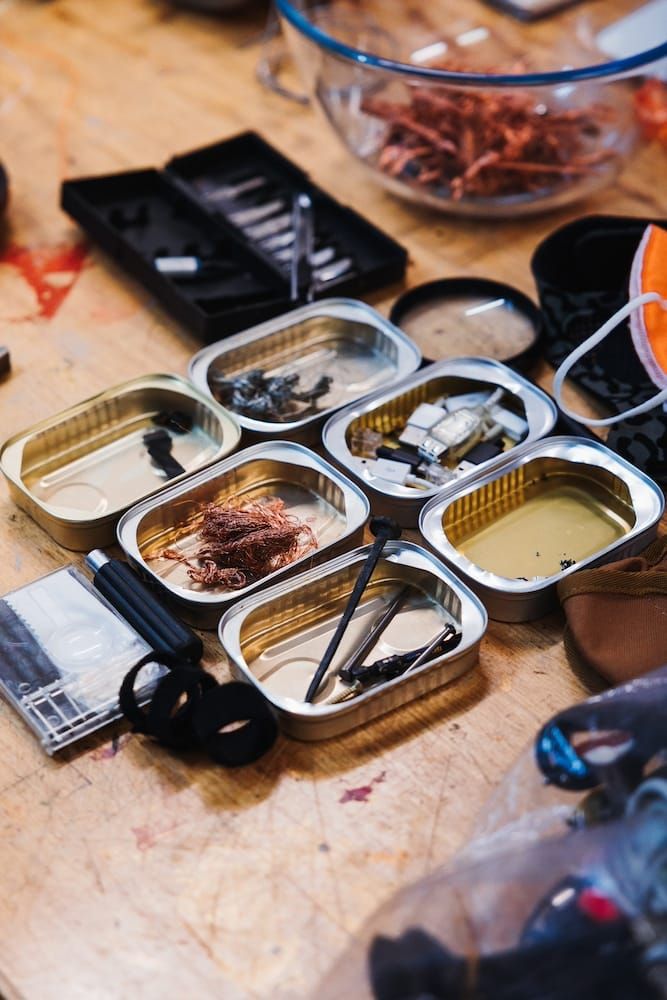
There are distinct aspects: one, that I was much impressed by, had to do with the creation of bullets. To do this, a process of harvesting copper was undertaken; there was an e-waste buyback, and copper was recovered from donated objects. Making art objects from recovered, recycled and re-used material is by no means new – the Resource cooperative has been doing this for a while. Nonetheless, this is an excellent idea, and Loren did this, and decided to make copper bullets. It fits the overall project: new skills are learned, and applied.
Copper is probably one of the most useful metals on the planet.
Humanity has a relationship with copper reaching back to Neolithic times; it was probably one of the first metals used to make tools, weapons and jewellery. This is partly because it’s what is known as a native metal – you can dig a chunk of copper out of the earth and it is ready to go; manner other metals need some form of smelting or processing. Copper has accompanied humanities journey with technology almost all the way: your smart phone has copper in it. There’s copper in your home, and there’s copper in you: it assists with metabolising oxygen.
Using copper has resonance, then.
Reclaiming copper from e-waste is even more interesting.
The actual recycling of e-waste, to gather useful material is complex work. If you did it as it’s regulated – and it is – recycling a lot of e-waste is costly. It’s also dangerous: e-waste can contain toxic substances such as lead, cadmium or mercury. You need to be careful when harvesting.
This kind of post-consumer extraction is a huge global activity. Much of it takes place in extremely unsafe conditions, in the global south, to no-one’s surprise. An illegal trafficking trade in e-waste has developed; much of it ends up in Ghana (see this BBC report). Usable material is extracted by unsafe methods. Kronemyer is doing something really useful by making anything from reclaimed copper, by doing it safely, and by doing it here. Making this process visible as an artwork is an excellent strategy; it covers a lot of ground. The addition of a process (which is somewhat bureaucratic and somewhat parodic, but also functional) that allows people who donated the waste product copper was harvested from to own a share of the end product is also interesting – it encourages an interest in what happens to the waste once it’s relinquished. This is the total opposite of what usually happens with all the stuff we chuck away; it’s removed from sight and mind. Someone else is responsible now.
Kronemyer is also responsible for showing us guns and guns being used. This is, again, important; the work is about guns in the end as well as reclaiming useful material.
Guns are, well, complex.
Guns are powerful symbolically; more than that, they are powerful floating or empty signifiers. They are objects that can be understood to indicate, potentially, a lot of different concepts, and equally potentially, a lot of differing, even opposing, ideological stances. I could say I think a hunter who focuses entirely on hunting feral animals in remote parts of Australia is doing a good thing, although I do not think I could join in with the activity[1]. Shooting at clay targets as a form of sport sounds almost fun, and certainly a great way to spend an afternoon
Using guns as a way of reinserting copper into the earth works as well, which is partially what making copper bullets could be for. There is a debate of copper versus lead bullets and copper is better than lead in an environmental sense, when it comes to bullets[2].
You can make anything work with guns, really – they are tools, as is often claimed. The problem comes with the presence of other, darker readings of guns, and any useful reading does not negate a terrifying one; as I write this, a man is hiding somewhere in the Victorian Bush after murdering police, with firearms. While I almost feel unfair bringing this up, the idea of a gun contains multitudes, and anything positive must exist alongside the difficult readings as well.
This is a bit like vampires; there’s the idea of a vampire, and there’s how it’s interpreted. You might consider how many differing kinds of vampire films there are: Twilight, Let The Right One In, Thirty Days of Night, Blade and Nosferatu all differ radically, yet are all vampire films that vary in popularity, but all are valid versions; Vampires are also very useful analogies for anything you can think of (Stephen King’s Salem’s Lot was once described as analogy for banks destroying small farming towns in America; Let The Right One In used vampires to approach ideas of gender and bullying. ).
Guns are more than guns; guns hold multiple potential ideologies. They can be symbolic of what we understand as Sovereign Citizen ideas, and also be commentary on how we treat the resources of the earth, and both readings can exist at the same time, one not achieving more validity than another, no matter what each take claims: the guy hiding in Victoria does not mean this is a bad art work.
It's certainly true that a lot of work was done to make the experience of Materiel World convincing and I think it does what it claims to do. The part of the work that discusses reclaiming material from waste and using it is quite wonderful. The success here is undeniable, and the work and effort is impressive, pointing to a massive environmental issue that has an actual solution.
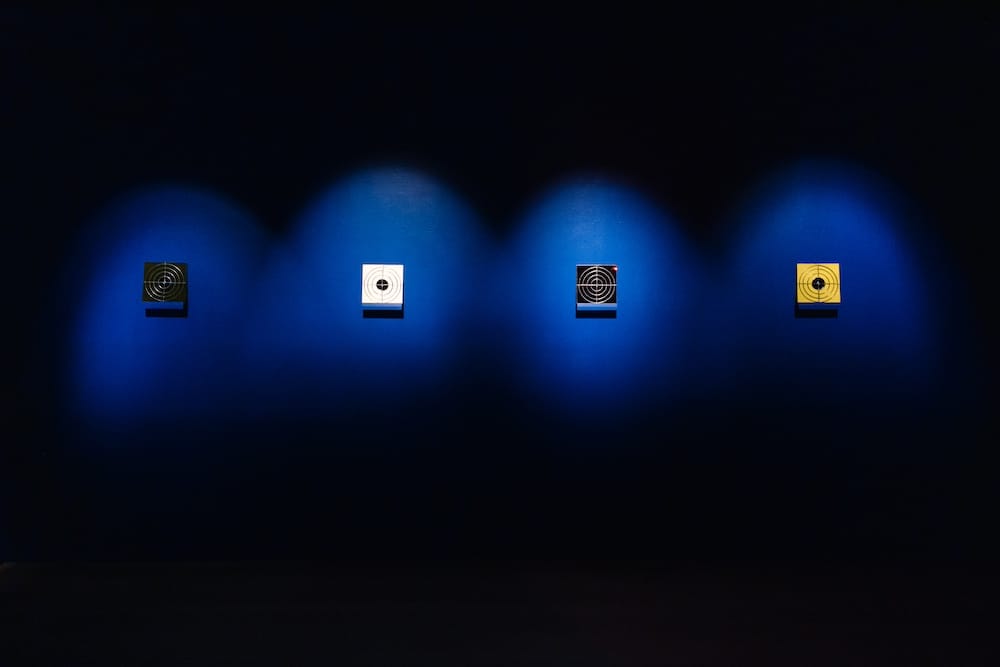
The central video work of people using guns is almost funny, certainly fetish-like,[3] in how it lingers over the acts involved. It’s also presented in a very controlled, educational way; all of which works to realise the aim (pun intended) of the art here. I can’t say this doesn’t work, but what work is being done?
Perhaps it’s that guns are being complicated by the art.
I don’t think any real attempt is being made to rehabilitate guns, which would almost necessarily fail, but I have to say I’m impressed by the creation of anything from refuse, and how that creative aspect of the work reveals a large global issue.
I can’t manage to ignore the violence that’s possible with guns, but I don’t think I’m being asked to; the experiment of the work is the moments when a working bullet is made and is shown to be capable of use. This implies that other uses of the reclaiming process are possible, and that there’s an environmental view that the work finds that can’t be ignored.
Guns are always going to worry me, terrify me, even if on a rational level I understand them to be more complex than just terrifying. After this exhibition, that understanding has expanded rather than altered, which, given where I started with considering this exhibition, is an achievement.
I’d love to see a further investigation and an expansion on the reclamation of e-waste – this felt like a genuine revelation that has far-reaching possibility for making new art; I think I’d like it even more if it wasn’t attached to firearms, but that was the point of this particular exercise[4]. Making me look at guns had me digging through many archives, and discovering that, in fact, gun ownership in Australia is rising , that there are issues with who can actually gain access to guns, and that people are even making their own guns; paying attention to this is becoming even more important.
This is a very, very useful exhibition that raises issues and demands engagement, and that’s one of the things that makes me care about art, and continue to be amazed by what art might do.
My quibble though, is this: guns are necessarily about an individual. If you have a gun, it is your gun, and you can do as you require with it. Getting right back to the original impetus for this project, the investigation of guns seems predicated on an understanding of survival that is based around individual survival; so to me, a gun is a less useful survival tool. If we want to survive disasters and futures that seem bleak, all my reading and observations suggest that the best technology for survival is technology that supports a community. An individual is less able to survive than a group, as far as I can tell, and while a gun might be useful in some ways to a group or a community, it also might not be.
My version of this project (which no-one has asked for) would be to make a radio station, and use the reclaimed copper to make simple radio devices that could receive a radio signal. Radio has been shown to be uniquely powerful in supporting mass survival in face of a disaster – think about it during a large bushfire event, which we all know is very likely to occur. Being able to broadcast and receive safety information can help a lot of people at once. I could tease this out for days, but really, what I’m describing is more about how I might answer a question of ‘what is useful for the survival of some kind of large disaster’ and for me, that’s going to be something that can be used to rapidly share information and support the continued existence of a community. Pump up the volume.
And I had finished this, at last, put it down to marinate, became distracted, the days ticked by, and then something happened.
There was a terror incident at Archer Park, Bondi Beach, on the 14th of December.
It is not news to say the perpetrators used guns. The guns they used were types that enabled rapid fire, yet were not semi-automatic weapons, as these were banned in Australia after the Port Arthur Massacre. The alleged shooters (I’m saying that as the sole living person is yet to come to trial) used weapons that enabled rapid shooting that were not popular in 1996, but have become more so since. There’s a lengthy, in depth and I have to say, potentially disturbing article about the guns it is believed the attackers here, and another that adds a bit more here . I also found an oldish AMA on Reddit started by someone who owns a type of gun that has, since the Bondi attack, been banned in Australia. It’s very interesting, but it’s also a Reddit discussion, and almost inevitably contains some bizarre comments of the kind you would probably expect to encounter in a discussion about the banning of guns.
I found a lot more as well, and I have to say I became quite disturbed. Guns have lost none of their power to haunt and terrify me. There’s a lot of detail I could pick out, too, that might go towards creating a kind of judgement call or verdict about the artwork I saw at CAT that has now, albeit in ebbs and flows, dogged me for ten months, partly freezing my mind. Which I guess is a testament to the overall success of the work, although I do not know if I’m really obsessed with the work at all, but with guns, and with violence.
Since I wrote the bulk of this, the man in the bush, Dezi Freeman, was killed in a standoff with police in March, while investigations continue into how he was able to remain on the run for seven months, and how he travelled some 150 kms to Thologolong where he was killed by police snipers; it is alleged he was carrying the gun he had taken from one of the policemen, Neal Thompson. A woman was arrested on July 17th as part of continuing investigations into the existence of a support network. Freeman was, at the very least, connected to a nebulous community of people known as Sovereign Citizens, and probably was one. The idea that there’s an underground network of these people, and that they are likely to be armed is chilling. Reading around Freeman took me back to the Train family and the shooting incident at Wieambilla, Queensland in 2022; the Trains were also influenced by Sovereign Citizen ideas, and other conspiracy narratives.
The more I look at these spaces, the more there is to find, and these narratives are frightening, not in the least because guns are accessible to people with extreme views, and from 1996 to now, they still are, in Australia, and too many other places. I find this hard to step away from.
Maybe I’m the wrong person to look at this art work.
But perhaps, that means I have to, and use my resistance to guns as a way in.
It’s certainly not a poor artwork, but it does feel unresolved, and I am unsure the idea of making bullets from reclaimed copper works for me. What I do like, very much, is the notion of investigating what is an oncoming economy – humanity will always need copper, yet it can be terribly toxic to mine, so reclaiming it is a future industry, and making art with it is a superb idea.
We will also always have guns, so despite my qualms and horrors, they need to be worked out and properly controlled, because they are fucking deadly and they fucking kill people. They kill children. They take away everything a person is, all their stories and dreams.
In my mind, there is a place where it is always 1996, and I’m in North Hobart, and I pause the mix tape and I see my friend’s face as he takes the phone call, and I remember what he told me. I will never forget. My friend Venom, he lives up to his name.
Andrew Harper
July, 2026
[1] This activity is pretty morally unassailable except for the actual ethic of not killing anything for food, and even with that in mind, someone who hunts rabbits or any feral animals and eats them has the added potential to claim they are saving more fragile species from extinction, which is likely true. I actually buy this as a better argument for guns than anything this exhibition does. Check this Instagram out
[2] I am though, a bit unconvinced because hanging onto the copper seems like it might be better for the environment,
[3] The slow-motion bits reminded me of Hong Kong action cinema, which is some of the most joyfully over the top violence I’ve ever come across.
[4] I’m still wondering why guns at all, of course. There are hints that understanding and knowing how to use guns is a useful survival skill, which it likely is, but it’s still something I would have way down the list under something like ‘fresh drinkable water’ or ‘building a radio station’; radio has proven use in all manner
If you liked this, share it with a friend. Sign up for more or consider supporting my work with a monthly or yearly donation. Your contributions keep me in coffee beans and our greyhound in beef liver treats.