And no birds sing

And this is why I sojourn here,
Alone and palely loitering,
Though the sedge is withered from the lake,
And no birds sing
– La Belle Dame sans Merci, John Keats (1819)
Someday, you will ache like I ache
– Doll Parts, Courtney Love, performed by Hole (1994)
If you’ve read the novel Bladerunner is based on, you will know that it is, at least in part, about animals. In Do Androids Dream of Electric Sheep, there has been so very much war and pollution and disaster, that almost all animal life is now gone, totally and utterly. Deckard, the central figure, wants to buy a live animal to replace his electric sheep; live animals have become status symbols, owned by the very wealthy.
In 1962, Rachel Carson’s book Silent Spring was published. The text had its germination when Carson’s friend, Olga Owen Huckins, forwarded her a copy of a letter she had also sent to the Boston Herald, four years earlier in 1958. The letter described birds dying after aerial spraying meant to kill mosquitoes near her property in Duxbury, Massachusetts. Carson thought this worth investigating, and spent four years researching the impacts of DDT and other pesticides on the environment.
Somewhat predictably, both the book and Carson herself were attacked, by the chemical industry. Lobbyists claimed that Carson was advocating a return to "The Dark Ages". Industry giant, Monsanto went so far as to rush into print a parody called The Desolate Year, which predicted famine if pesticides were banned.
Silent Spring hadn’t actually called for banning, but focused on limiting usage of DDT. Nevertheless, Carson was called a fanatic and a communist.
The venomous assault on Silent Spring ended up creating interest in it, and Carson’s scientific rigour stood up to criticisms. Appearing on television, Carson read sections of Silent Spring on a CBS Reports special, The Silent Spring of Rachel Carson. Actual viewing figures are hard to ascertain, but it seems some ten to fifteen million people viewed the show; the book was already a sensation, having been serialised in the New Yorker, and then selected as a Book of The Month in the venerable, trusted Book of the Month Club, that sent copies to subscribers all over the US.
Carson went on to testify before John F Kennedy’s Scientific Advisory Committee, and the US Senate subcommittee. As a result, DDT and other pesticides became strongly regulated, and still are.
Carson did all this while being treated for cancer.
She was forced to decline many invitations, but attended those she was able to, between receiving and recovering from radiation treatment.
Rachel Carson died in 1964, less than two years after Silent Spring was published.
Since 1962 Silent Spring has remained both revered and savagely critiqued.
Even now, it is blamed for deaths caused by malaria. Africa Fighting Malaria, an NGO based in Washington DC and South Africa is one such accuser. It’s an interesting organisation, it's basic position is that environmental organisations ignore the health of Black Africans. It promotes market-based solutions and economic freedom as the best way to improve lifestyles in poorer countries. AFM is funded by ExxonMobil, and it’s been alleged to be engaged in climate change denial. Which is quite a thing, because it’s very likely climate breakdown will lead to an increase in the spread of malaria.
The Competitive Enterprise Institute, based also in Washington DC, does not like Silent Spring either. CEI, founded in 1984, is a libertarian organisation that promotes less government regulation, free enterprise, personal liberty and global warming alarmism (one claim of theirs is that climate change is a good thing). CEI was, as far as I’m able to tell, founded to combat the flourishing environmental movement of the 1960s.
In 2009 this organisation was responsible for a website falsely blaming Rachel Carson, who had been deceased for over fifty-five years, for millions of deaths due to malaria. This is particularly wild, as the US ban on DDT did not extend outside the US. Other places simply abandoned use of DDT because it no longer works. Due to the short life cycle of the mosquito and huge number of offspring that are produced, the resilient mosquito simply became pesticide-resistant in the face of widespread use of DDT.
Of course, malaria was never the point.
The real point is to create doubt in science.
Like the tobacco industry before it, the fossil fuel industry has seeded such doubt throughout the world with increasing frenzy since the 1990s. We broadly understand, I think, the impact such doubt has. If you look hard, you will ascertain that while the content and target of such campaigns might change, the form rarely does: doubt attacks the way information is communicated and presented, twisting and propagandising. Scientific information is particularly vulnerable to this form of manipulation and click-bait sloganeering, because scientific research necessarily produces outcomes that are often complicated, hypothetical, incomplete or open to multiple conclusions.
This is why Silent Spring important, not just because of its well-researched and focused content, but because Rachel Carson could really write. Silent Spring is science made compelling. Carson's lyrical realisation of scientific fact makes her book the powerful and impactful statement it is. It is a work of art. Art that, when merged with responsible and accurate scientific research, changed the world. That the book was, and remains, so vigorously assaulted by its detractors only demonstrates its importance. Rachel Carson remains a figure of utterly extraordinary resilience and heroism. She stood publicly against assaults by misogynistic capitalists even as she was dying.
Recently, I was perusing Instagram, when I stopped scrolling, my attention held by a soft sculptural work made by Gabbee Stolp: a dead bird, a brown skua. It had not been made to be realistic, yet the work was delicate and haunting. It recalled to me other dead birds, their absolute stillness.
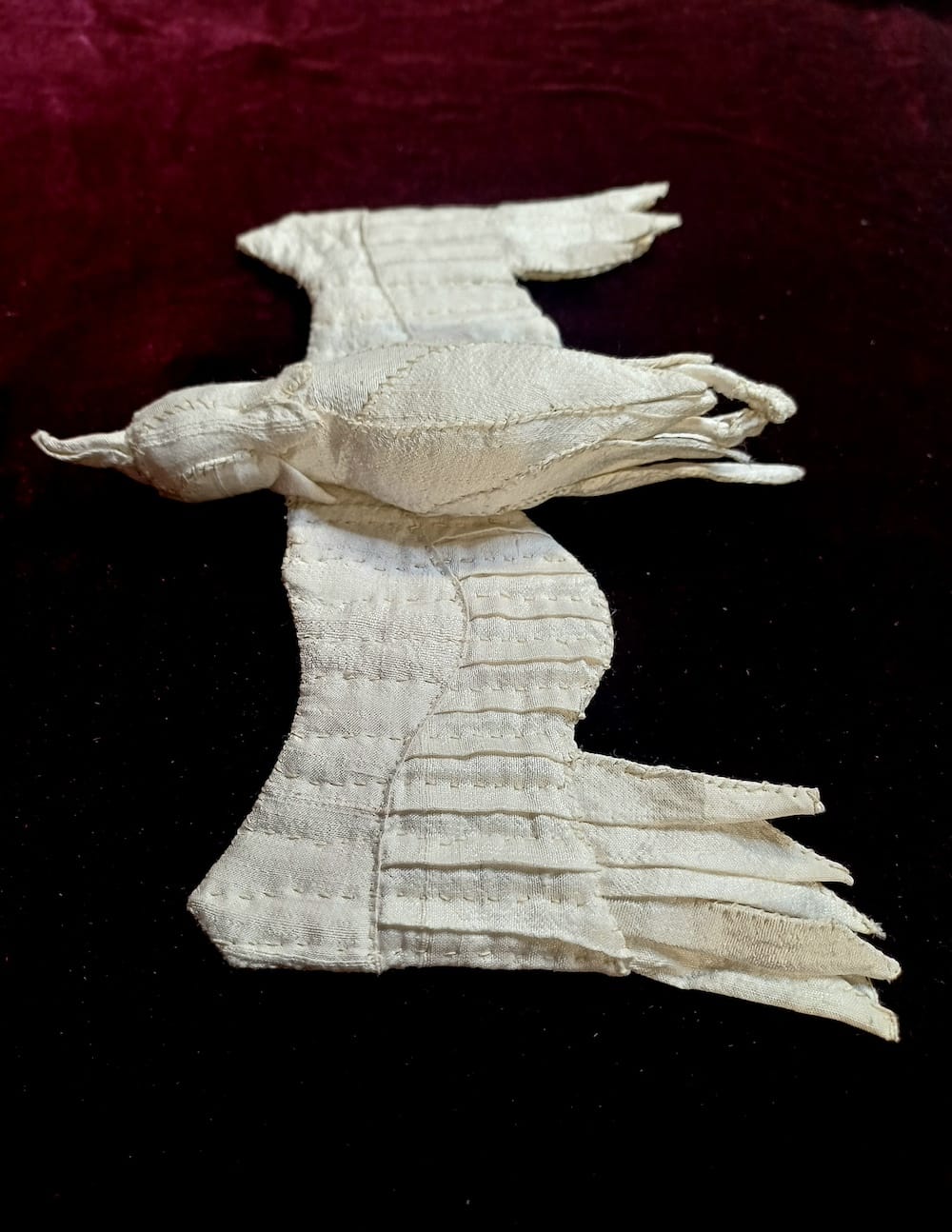
Gabbee’s work is informed by her resolute and personal empathy with the natural world. She knows enough about the anatomy and physiology of animals and birds to produce work that has a quality of absolute reality, even where the forms are simple and pared-back to their essential parts. Her brown skua makes it perfectly clear that she understands what the lifeless body of a bird really looks like. Her soft sculptures have a weight and a stretch to them you can see, the realness of touch and execution gives the works gravity. They speak resoundingly of a genuine tragedy, and of grief. Even in this digital square, the sadness with which this delicately sewn effigy was made, is utterly present.
The Brown Skua is probably the bird that bought avian influenza (HPAI) H5N1 to Australia. A Skua, and a Giant Petrel, were found on a beach near Esperance in Western Australia. Avian influenza had finally arrived at the last continent to be free of it.
Millions of birds and animals have been killed by this pathogen. According to the Bird Flu Tracker, H5N1 arrived here, to the shores of Lutruwita, on the 12th of August, once again carried by a Brown Skua.
Brown Skua are big, tough carnivores. They fly the southern regions of our planet, covering vast distances. They feed partly through kleptoparasitism: they harass and bother terns, petrels and gulls until those unfortunate creatures relinquish or even regurgitate their catch. Skuas also rudely infiltrate penguin colonies and devour eggs and smaller penguin chicks. They scavenge and dine on seal carcasses and the remains of other sea birds, they catch fish and squid from the ocean when they can, and they follow fishing boats and quickly hoover up anything turfed back into the water. They are aggressive, impolite, and bold, defending their tightly defined territories against all comers with great ferocity in breeding season: larger birds, seals, even humans, are subject to relentless aerial attack.
Skuas are also smart and apparently able to recognise individual humans. Sophrony Kirilov, a Russian Orthodox priest resident at The Holy Trinity Church located on King George Island, Antarctica, reported in 2015 that during his four-year tenure at the remote traditional church, he gradually formed a friendship with a trio of Skuas. He would feed them fresh fish, and the Skuas would hang around the door to his small dwelling. Kirilov recounted that he would speak to them, and that they grew so comfortable with him, that they would play tricks: once his pointed hat was the focus of an attempted theft.
Brown Skuas are complex, wild, intelligent birds but their manner of predation and feeding could be described as opportunistic and bullying. Not the greatest poster children for an environmental campaign.
Yet, it is right and proper that Gabbee Stolp honours them, and mourns for them.
Their faults, their bolshiness, and their cleverness makes them entrancing. The intelligence of all manner of birds has been greatly underestimated, and the scant evidence that we have suggests the Skua is a particularly clever animal. They’re pirates; stealing, sneaking, exploiting angles, hunting, tricking and surviving. They have their place in the vast interlocked ecology of the Southern Oceans, and they reach from a tiny church in Antarctica to the shores of Lutruwita.
Gabbee's soft rendering of a single deceased skua is reverent. It reveals the artist’s personal relationship with nature, and particularly with sea birds. By constructing this work, and other, similar soft sculptures, Gabbee seems to share a personal grief at the effects of avian influenza, processing it through her hands, as the animal comes alive again. An act of entirely secular veneration. It is more than sadness. It is a ritual of mourning.
It is not enough to note that there are millions of dead birds and that there will be millions more. With her own hands, Gabbee makes a dead bird.
The bodies of creatures taken by avian flu are potentially dangerous even after death. They must be correctly disposed of, yet it is important that we might actually visualise this loss. There is time sewn into this soft sculpture, its rough material and method of construction echoing that of a shroud. In a culture that deeply fears death and hides from it, this action is a quiet but firm statement.
It is also a question: more birds will likely die.
Avian influenza is a minor news item, but it is serious. While I have written and researched this piece, other animals have been detected with H5N1. There will be more losses, and in a moment where the global ecology is so under threat, when the loss of so much biodiversity is occurring, the possible effects are terrifying.
As of October 27th, according to Australian Geographic, there have been 700 cases across varying bird and animal species since the disease was first found in Australia. Substantial efforts are being made by Birdlife Australia to organise amateur bird watchers to observe and spread accurate information. They are also calling for more funding from the Albanese Government. $200 million is needed over the next two years to support bird and animal resilience. If you’re able to do so, there’s a link here where you can send an email supporting a funding increase.
I discovered this call for support, and followed it, and wrote this, because I saw a soft sculpture of a Brown Skua, and it moved me. While I knew about avian flu, that piece of art is why I took action. I’d heard of Silent Spring before, but I dug into it because I saw a soft sculpture of a Brown Skua, and the story of that book, and what one person might accomplish, spoke to me.
I draw a line between Gabbee Stolp and Rachel Carson: though their art forms are vastly different, both of them were moved by the mass death of birds. They both took action using the materials, skills, empathy, and courage they had to hand.
Art alone is not going to save the world, but it can do things. Just as Gabbee Stolp’s work sent me on a voyage, maybe this thing I’ve written will do something for you, cause you to take some action. That’s what art can really do: when it’s good, when it is made with genuine reverent empathy, it can move that bit further out from the one person who made it, to a writer who was touched by it, to you reading this now, and maybe some of you might find a moment to send an email, or share this piece of writing. So, one by one by one, art does something.
Because I really do not wish to know a world where animals have become status symbols, owned by the very wealthy, where no birds sing.
For Rachel Carson
- Andrew Harper, November 2026
One more thing...
Financial support of Make and Do keeps me in coffee beans, tea bags and almond milk (which, in this economy, is no small thing). If you are able to upgrade to a paid subscription you can do so by clicking the button below, which will take you to a secure payment situation.